Showing posts with label barn owl. Show all posts

14 September 2025

2025 Barn Owl update

After the highs of 2024, we were sadly hit by the lows of 2025 as far as Barn Owls go. Whilst the very wet spring of 2024 saw a flush of early grass growth (and presumably an increase in vole numbers), the very dry early spring of 2025 saw the complete opposite, resulting in by far the worst year we've seen since the start of the project.

The average clutch size of 4.3 eggs was the lowest we've seen, which obviously fed through to lower brood sizes. However many sites failed before hatching. We generally only see one or two failures annually, where eggs were laid but later failed, but in 2025 the figure was 16, a staggering 14% failure rate!

For sites where chicks survived to ringing, the average brood size of 2.4 chicks was again the lowest we've ever recorded, which led to just 96 chicks being ringed, the lowest since 2017.


2015 2016 2017 2018 2019 2020 2021 2022 2023 2024 2025
Sites visited 41 47 64 85 87 106 93 112
127 150 126
Unoccupied 11 12 23 34 36 43 35 34
29 66 47
Occupied, no breeding 7 8 5 4 3 4 5 4
10 4 8
Average clutch size
(where observed)
4.6 4.6 5.3 5.2 4.7 4.6 4.5 4.5
4.6 5.4 4.3
Average brood size
(where observed)
3.5 2.8 3.0 3.3 3.0 3.2 2.8 3.1 3.2 3.2 2.4
Chicks ringed 70 47 90 132 119 177 133 189 193 209 96
Adults ringed/recaught 17/8 14/9 21/14 18/14 16/15 22/17 19/17 20/22
30/24 22/35 34/25

The most productive area once again appeared to be Penwith (average of 3.3 chicks per brood) with the lowest central Cornwall (2.0) and Lizard (2.1). Although we caught roughly the same number of adults this year (59 vs 57 last year), fewer of these were already ringed (42% vs 61% last year), which perhaps suggests more turnover of breeding birds this year.

As usual, if we look at movements, fewer recaptures will obviously have produced fewer movements. These movements in general seemed to be longer than in 2024 (see the 2024 map below the 2025 map), but the average was similar at 7.6km (8.5km in 2024), with the furthest being 20.2km. This again maybe suggests birds were moving around more in 2025, perhaps searching for better breeding sites.

2025 movements between breeding sites

2024 movements between breeding sites

13 November 2024

2024 Barn Owl update

We thought that 2023 was an odd year for Barn Owls, but 2024 seemed to continue the trend! The very wet spring was perhaps a boom for early grass growth, with a consequent increase in vole numbers. So 2024 saw our highest ever average clutch size (5.4), with three clutches of eight eggs being found.

This didn't necessarily feed through into large broods though, with the average (3.2) very much in line with the last couple of years:


2015 2016 2017 2018 2019 2020 2021 2022 2023 2024
Sites visited 41 47 64 85 87 106 93 112
127 150
Unoccupied 11 12 23 34 36 43 35 34
29 66
Occupied, no breeding 7 8 5 4 3 4 5 4
10 4
Average clutch size
(where observed)
4.6 4.6 5.3 5.2 4.7 4.6 4.5 4.5
4.6 5.4
Average brood size
(where observed)
3.5 2.8 3.0 3.3 3.0 3.2 2.8 3.1 3.2 3.2
Chicks ringed 70 47 90 132 119 177 133 189 193 209
Adults ringed/recaught 17/8 14/9 21/14 18/14 16/15 22/17 19/17 20/22
30/24 22/35

The most productive area seemed to be Penwith (average of 4.0 chicks per brood) with the lowest being Roseland (2.4) and East Cornwall (2.9). For only the second year, we also recaught more ringed adults than we ringed new birds, which is very satisfying.

As for movements, the map below shows the origins of birds recaught as breeding birds in nestboxes during the 2024 season. As expected, most of these is short distance dispersal of young birds, on average 8.5km but ranging from 1.7km up to 37.2km.

This only relates to recaptures though, but we unfortunately also hear of many of our birds found dead. In 2024, 11 of our birds were reported dead, including three hit by cars and one that hit wires.


29 May 2024

Barn Owl throuple and other odd goings on

Over the long bank holiday weekend we had a chance to make our first visits to Barn Owl nestboxes across part of our patch. It was a long slog, with plenty of sites covered and overall it seems to be an early season with several broods of good-sized chicks and even some not too far off ringing age. But of more interest were some of the 28 adults caught over the weekend (just eight were new, unringed birds), which had some surprising histories.

Overall, there were plenty of short movements, which is what we'd expect from dispersing juveniles, but you can see from the map below that these birds generally don't go too far. The longest movement of the weekend was a bird ringed as a chick in 2023 near Probus and now residing in a new box put up at the National Trust offices on the Roseland!

The strangest happenings were saved for the Lizard though. On the expected end of the spectrum was the new pairing at one site, with both of the pair ringed locally as chicks, in 2022 and 2023. In the middle of the spectrum was a breeding female ringed near the Helford river in 2020, then recaught breeding down near Goonhilly Downs in 2022, was then back up near the Helford to breed in 2023, and now breeding in another box near Goonhilly Downs again this year (below), so four sites in five years!

The far end of the weird spectrum though was at another site near the Helford, where the nestbox camera showed two birds in the box, but we could also hear chicks hissing on a nearby ledge. As we put a ladder up to check the ledge a female flew off, with the ledge home to an impressive seven chicks and an egg, which may well still hatch. We don't see many clutches of eight, but this was our fourth of the weekend. So who was in the box? Well one bird was the regular male that's been breeding there since 2020, but the other was a male ringed as a chick at a site 10km away in 2022. It'll be intriguing how this throuple get on and I must admit it's a first for me.

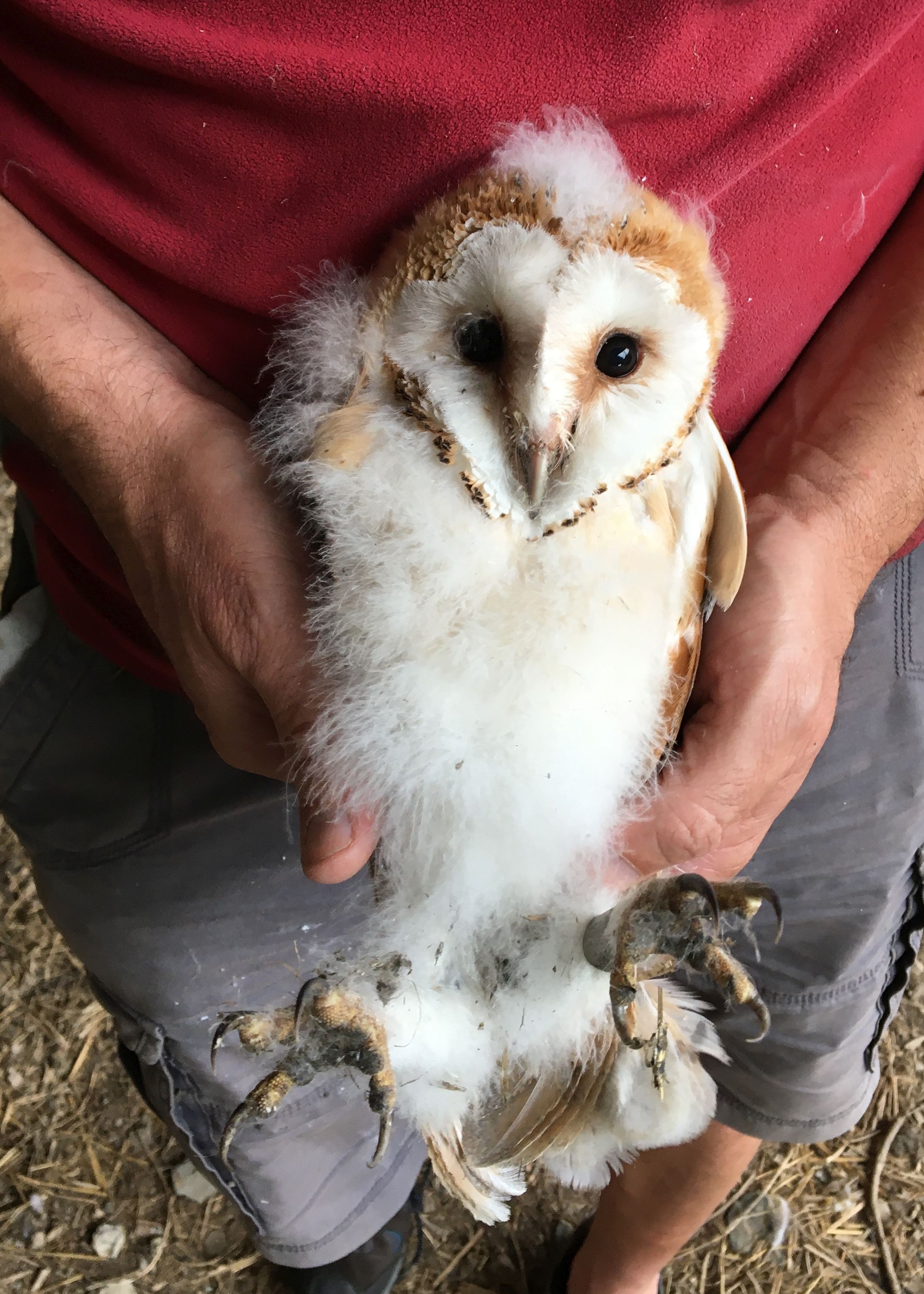
We couldn't have a Barn Owl post without a photo of a Barn Owl, so here's a few of the various stages we found, including just some of the largest larder we've probably ever seen.


30 July 2023

Barn Owl 2023 update

After one of the strangest springs weather-wise, the Barn Owl season seemed to be all over the place in 2023. We had regular sites unoccupied, non-breeding birds at some sites and some exceptionally late broods. Even now we have a few sites where we need to revisit to ring chicks!

With some new funding from the FiPL project (Farming in Protected Landscapes) managed by the Cornwall AONB, we are continuing to expand our monitoring, this year onto the Roseland peninsula, with some new ringer recruits this year as well from the National Trust.

Our totals for the year were still quite impressive (note we've knocked off a couple of the early years to make space):


2015 2016 2017 2018 2019 2020 2021 2022 2023
Sites visited 41 47 64 85 87 106 93 112
127
Unoccupied 11 12 23 34 36 43 35 34
29
Occupied, no breeding 7 8 5 4 3 4 5 4
10
Average clutch size
(where observed)
4.6 4.6 5.3 5.2 4.7 4.6 4.5 4.5
4.6
Average brood size
(where observed)
3.5 2.8 3.0 3.3 3.0 3.2 2.8 3.1 3.2
Chicks ringed 70 47 90 132 119 177 133 189 193
Adults ringed/recaught 17/8 14/9 21/14 18/14 16/15 22/17 19/17 20/22
30/24

Unsurprisingly there was again some variety in the brood sizes across the area, with the highest average again along the north coast fared the best though (average brood size of 3.7), followed by the east of the county (3.5, compared to just 2.3 last year) and then 3.0-3.1 elsewhere.

There seemed to be more movement between sites this year, with one adult even on its third site in as many years! The movements between bixes (mostly birds ringed as chicks dispersing) are shown here.


19 October 2022

Barn Owl 2022 update

It's been a strange summer for lots of our regular projects, with freak weather, bird flu and remnants of Covid still making life difficult. Some of our birds have fared particularly badly, with Kittiwake reduced to just one successful sitre across Cornwall, a crying shame.

Our Barn Owl monitoring continued pretty much unaffected though and despite the drought, birds actually seemed to do OK. The project continued to grow and we personally visited over 100 boxes for the first time, which is no mean feat. Despite clutch sizes being nothing special, birds survived quite well and were about average.


2012 2013 2014 2015 2016 2017 2018 2019 2020 2021 2022
Sites visited 34 32 44 41 47 64 85 87 106 93 112
Unoccupied 7 12 11 11 12 23 34 36 43 35 34
Occupied, no breeding 2 7 7 7 8 5 4 3 4 5 4
Average clutch size
(where observed)
4.1 3.6 4.6 4.6 4.6 5.3 5.2 4.7 4.6 4.5 4.5
Average brood size
(where observed)
3.1 2.4 3.5 3.5 2.8 3.0 3.3 3.0 3.2 2.8 3.1
Chicks ringed 46 20
63 70 47 90 132 119 177 133 189
Adults ringed/recaught 11/9
3/4 9/13 17/8 14/9 21/14 18/14 16/15 22/17 19/17 20/22

It did seem that pairs along the north coast fared the best though (average brood size of 3.7), followed by Lizard and Penwith (3.4), central Cornwall (3.0), whilst those in the east of the county suffered most in the dry weather (just 2.3).


We continued our run of bizarre movements as well, with a non-breeding male (with a regular female) in an established site in Penwith having been ringed as a chick in 2017 in Northumberland. This is our furthest movement to date (at 587km) and it'll be interesting to see if it stays to breed now.

We sadly also received three reports of ringed birds dead on the A30 during the year, all on the open dual carriageway between Carland Cross and Fraddon. Along with a bird that had to be put to sleep after becoming tangled in a barrbed wire fence, this was a poor year for our chicks.

16 August 2021

Manxies, some very late owls and a Norwegian Curlew

We've been busy over the last couple of weeks, so have a few bits of news to share.

Over the August new moon we ran two Storm Petrel public ringing demonstrations, aiming to give people the rare chance to see these amazing birds up close. The visitors to Porthgwarra were not only treated to seeing a few Stormies in the hand (and enjoying their distinctive smell), but also a couple of Manx Shearwaters! These are only the second and third we've caught in Cornwall so it was incredibly lucky to have two on the same night. As far as we can tell, only 28 Manxies have ever been caught in the county, including seven in 2002, one by the ringing group at Lizard in 2015 and now two more.

Over the weekend we also took the opportunity to visit the last two active Barn Owl sites we monitor. both of which we think are replacement clutches after an early failure. Sadly one of these didn't progress past two eggs, but the other had a brood of very young chicks (and possibly two unhatched eggs), so these are likely to be ready to ring in September. We rarely ring chicks this late in the season and in fact we've only ever ringed one brood in September, on the very late date of 22nd September 2020.

Lastly, we were contacted this morning by the Head Greenkeeper at Newquay Golf Club as one of their staff had found a dead Curlew on the course, sadly predated. The bird was ringed though and is in fact the first ever Norwegian-ringed Curlew to be found in Cornwall. We've had birds from Sweden and Finland in the past, but this bird completes the Scandinavian trio, so it'll be interesting to see where and when it was ringed.


13 July 2021

Busy seabird weekend

This long weekend has been a busy one, with various group members (and even a visitor from up-country) heading out to all parts of West Cornwall in search of (mostly) seabirds.

We started off with our annual gull-ringing trip over to Mullion Island, which was always going to be an unknown as we were too busy colour-ringing Cormorant chicks on our last visit to count the Great Black-backed Gull nests. We headed over in two kayaks and a dinghy, landing in a quiet cove and heading onto the top of the island. Working our way round we ringed just 10 chicks, but at least another 10 were too big to try to catch. Whilst there, we were also able to photgraph a couple of ringed adults, both of which had been ringed as chicks in 2016 but are now breeding on the island. Interestingly, one (L:CN5) had been ringed as a chick on Looe Island, but has been seen a few times around Lizard and Coverack since.


Next stop was a tour of Barn Owl sites around the Lizard, ringing chicks at 10 sites in total. Several of these later broods had just two chicks, in contrast to those earlier in the season that had three or even four chicks.

Back on the seabird theme, the next day found us Kittiwake ringing at Trewavas Head. Half of the team paddled round from Porthleven while the other half walked in with a ladder from Rinsey. We all reconvened at the cliffs to scramble down and kayak round to the main Kittiwake site. With very few birds successfully breeding, we only colour-ringed eight chicks, but at least this is better than the zero of the last two years. We also took the opportunity to read various colour rings at Trequean zawn and also managed to get photographs of two metal-ringed birds. One of these (ET44236) was ringed on the Isles of Scilly in 1999 and had been seen by us at the engine houses colony in 2018 as well, so is a healthy 22 years old now. The other rewmains a mystery at the moment, with the BTO team looking at the possible options for us of what might be a very old bird!


After an extra couple of owl boxes, we then headed down to Porthgwarra for dusk to set nets for Storm Petrels. This is often the busiest month for Stormies and true to form the first net round before midnight saw 45 birds in the nets, so it was a busy session for everyone. In total we ringed 95 birds, with recaptures of a French-ringed bird and others ringed on the Calf of Man (in August 2020), St David's, Pembrokeshire (in July 2020) and one of our own from Lizard (ringed in July 2020). Talking of Stormies, we also heard from the BTO that a bird we ringed at Lizard in August 2020 was recaught on Alderney, Channel Islands on 10th July.

So al in all a very productiove weekend of seabird ringing, contributing to our ongoing colour-ringing projects for some of these species.

30 July 2020

2020 Barn Owl update

With the first Barn Owl broods now all ringed and boxes monitored, it's a good time to take stock and see how the season has gone. Averaging out the numbers in the table below, we can see that the project continues to grow and for the first time we have data from over 100 boxes which is a greeat achievement. The occupancy rate contineus to be relatively low, but we hope that previously unoccupied boxes will be taken up by new pairs as the years go by. Of the boxes monitored, clutch sizes appeared to be slightly down on previous years, but the subsequent brood sizes didn't necessarily reflect this. The figure of 3.2 hides a much more complicated story though.


2011 2012 2013 2014 2015 2016 2017 2018 2019 2020
Sites visited 32 34 32 44 41 47 64 85 87 106
Unoccupied 2 7 12 11 11 12 23 34 36 43
Occupied but no breeding 13 2 7 7 7 8 5 4 3 4
Average clutch size
(where observed)
4.8 4.1 3.6 4.6 4.6 4.6 5.3 5.2 4.7 4.6
Average brood size
(where observed)
3.1 3.1 2.4 3.5 3.5 2.8 3.0 3.3 3.0 3.2
Number of chicks ringed 33 46 19 63 70 47 90 126 119 170

It was apparent as the season progressed that brood sizes (and numbers of chicks ringed) was decreasing, but this is always hard to measure. But if we simply look at the number of chicks present at ringing through the season then a trend does seem to appear. The sample sizes are rather low, but we do think there's something in the data.

The much lower brood sizes later in the season we presume was due to the period of very unsettled weather, with plenty of rain. This makes feeding very difficult for adults which obviosuly has knock-on effects for chicks. We hope to be able to place cameras in numerous boxes over the winter (watch this space on that), which will give us much better data over the coming years.

15 June 2020

More Barn Owl visitors from up-country

Following the recent arrival in one of our boxes of a Barn Owl from Manchester (details here), yesterday saw another visitor from up-country. Whilst visiting a regular nest site at Tregarne (St Keverne), a male bird flew out of the barn as we approached, but we managed to catch the female in the box, where she was sat with four downy chicks. Noticing she was ringed, we presumed it was the female we ringed there in 2017, but it was actually a female that had been ringed as a chick in 2017 at a site near Gweek (8km away). Oddly, this bird had bred elsewhere in 2018 and 2019 (near Crosslanes), 9km from where she was now nesting, so must have been a new arrival here.


As if this wasn't interesting enough, we then removed the bulk of an old Jackdaw nest in the box in the adjacent barn, finding the body of a long dead Barn Owl built into the nest. This bird was also ringed and remarkably was a chick from Devon ringed in 2019. When this bird arrived at Tregarne we won't know, but it must have been late winter or spring to be built into the Jackdaw nest, but there must have been some fight with two new females arriving at the same site to take it over!

3 June 2020

Visitors from up-country

We recently received details from the BTO of a nesting Barn Owl we recaught in on of our boxes at the end of May. We mostly catch our own birds, ringed as adults or chicks, but just occasionally we welcome a visitor to Cornwall. GR53474 is now breeding in a box near Fraddam, but had been ringed in 2017 as a chick at Irlam in Greater Manchester, over 420km to the north!

Since we've been monitoring Barn Owls in the county, the only other long-distance visitor we've recaugt was a bird ringed as a chick in Suffolk in 2017 that was breeding in Newbridge the next year (see here). Apart from that, a bird ringed as a chick in Cumbria in 1990 was found dead near Golant in its first winter and incredibly we have also had birds ringed in Germany an The Netherlands found here.


The same day the Irlam Barn Owl was caught we were also able to catch up with another visitor from the north (the second line on the map above). Red AXF was ringed as an adult on Puffin Island off Anglesey in summer 2016 but since then has found Cornwall to its liking, breeding ever since at Western Cove, Portreath.

8 June 2019

Breeding season hotting up!

It's been a while since we updated on the start of the breeding season, so this is a quick tour of some of what we've been up to recently. Most recently we've had our first session out ringing Storm Petrels and managed to get teams out to Lizard and Porthgwarra on the same night. PG won out, catching 52 birds, including birds originally ringed in France and on Skokholm Island, Wales (as an adult in 2016). The Lizard team caught 22 birds, but also two birds from elsewhere: birds ringed in 2018 at Portland, Dorset and on Bardsey Island in North Wales.

Aside from that, we've mostly been counting and ringing chicks recently, including Chough, Dipper, Cormorant, gulls and Kittiwakes. It's been fun as well monitoring successive Robin nesting attempts at Penventon Garden Centre, nesting in amongst some of the plant displays! The first fledged two chicks, with two dying in the nest (lack of food due to the baked-hard ground perhaps?), and the second attempt (photographed below) currently has five chicks.


We're also well into the first checks of the Barn Owl season and whilst some pairs are only just hatching chicks now, others already have chicks that are 5-6 weeks old!

One of a brood of five chicks ringed last week on the Lizard

A rather unusual barrel nestbox we found removed from an old site near Marazion.
There must be some pirate heritage in birds that nest is such an impressive barrel.
Whilst most of the owls we've been ringing have been in boxes, it's also been busy in the owl hospital at the Screech Owl Sanctuary. We've already made several visits this year to ring birds before release and our last visit saw us ringing three small chicks (including the very rusty bird below), an older chick and an adult.


Away from ringing, we've now managed to count the gull nests on Mullion and the total of 71 is on par with previous years, though the number of eggs and chicks is second highest we've seen.


2013 2014 2015 2016 2017 2018 2019
GBB Gull nests - 62 37 83 70 60 71
GBB Gull eggs/chicks 98 174 90 204 166 - 195
GBB Gull chicks ringed 4 17 12 13 5 3 -
Cormorant nests 24 52 50 39 47 38 47
Cormorant chicks ringed 11 19 7 16 0 0 14

We've also seen the first Kittiwake eggs of the year, at Rinsey. At the same time some of the Shag chicks are already close to fledging!

The main zawn at Rinsey, sadly now pretty much devoid of Kittiwakes
and with drastically-reduced Shag numbers


Next on the agenda is trying to up our numbers if colour-ringed adult Kittiwakes and then we'll be thinking about gulls and more owls! It never ends...

14 August 2018

Cornish Barn Owls in 2018

With all of our Barn Owl sites now visited for the year, it's a good time to crunch the numbers and see how they've fared this year. This is our eighth year of monitoring boxes in Cornwall, but we'll just compare 2018 to the last five years for ease:


20132014 2015 2016 2017 2018
Sites visited 32 44 41 47 64 85
Unoccupied 12
(38%)
11
(27%)
11
(27%)
12
(26%)
23
(36%)
34
(40%)
Occupied but no breeding 7
(22%)
7
(18%)
7
(12%)
8
(17%)
5
(8%)
4
(5%)
Average clutch size
(where observed)
3.64.6 4.64.65.3 5.2
Average brood size
(where observed)
2.43.5 3.52.83.0 3.3
Number of chicks ringed 1963 704790 126

The larger number of boxes visited is due to the funding from Paradise Park which has allowed us to really expand the scope of the project. There are several more new sites for 2018 as well which we hope will be occupied in the coming years. The high rate of unoccupied boxes is also due to the large number of new sites that birds have yet to move into.

However, we did see several regular sites unoccupied for the first time which may well be due to the mortality over the hard late winter weather. These two periods of snow cover won't have made it easy for birds to get in condition for breeding and it does seem that some regular sites weren't occupied, but those that did breed made the most of the good spring weather by laying quite big clutches (including a clutch of seven at one site). But we then saw one of the hottest and driest periods on record, which seriously stunted grass growth, and no grass means no voles. So most sites then saw significant brood reductions, though the average of 3.3 chicks still compared well to previous years.

We also think the 'Beast from the East' has had a greater impact on the breeding population than you might think, apparent by the number of birds breeding in their first year. This summer we've caught 15 adults already carrying rings, of which six were ringed as chicks in 2017. Compare this to the totals from the previous few years:

Year Ringed adults
caught
Ringed as chick
previous year
2018  15 6
2017 11 0
2016 9 2
2015 8 2
2014 13 0

We can only assume that these birds (some at regular sites) were new recruits following the death of an 'original' adult, but if this has happened across the whole population then that my lead to quite a drop in the average breeding age. But that's why we do what we do and what the project is all about; understanding these changes in the county's Barn Owls.

16 July 2018

Cracking Stormie night and more French Kittiwakes

Same old, same old it seems at this time of year, but when the 'same old' is ringing Barn Owls, Kittiwakes and Storm Petrels then it's not so bad! With over half of our second visits to owl boxes now completed, it looks like the good start to the year hasn't quite come to fruition. Out of the clutches of five or six eggs we were seeing, we seem to be down to broods of just two or three chicks now, which perhaps isn't surprising considering the weather. It might be glorious out there, but the lack of rain means a lack of grass growth and a lack of rodents, so not good for demanding owlets! It's not all been bad news though and we have still seen a few broods of four or five chicks.


Sometimes the adults are just all very relaxed at nest visits,
watching from a handy perch!

Aside from owls, we had our first big Storm Petrel catch of the year at Gwennap Head, Porthgwarra at the weekend. A long busy night saw us ringing 159 birds, also catching six BTO-ringed birds from sites as diverse as Calf of Man, Cape Clear and Hartland Point, Devon. We also caught one French-ringed bird which I have a feeling is an old one, so it'll be interesting to see when that was ringed.

Last but not least, we caught up on some Kittiwake ringing and resighting recently and managed to ring 24 chicks at Trewavas Head. It's a real pity here that most nests are out of reach of a double ladder, but I guess they need to be safe from the Cornish swell! A quick look at Cornish resightings so far in 2018 shows that we've now seen 26 different French-ringed birds this year; eight at Trewavas Head, eight 'loafers' at Lizard, six at Ralph's Cupboard, Portreath and three at Rinsey. This is even more impressive when you consider that to the end of 2016 there had only been 92 reports of French-ringed Kittiwakes in the UK outside of Cornwall! We're sure there are many more out there, so we'll be out again in the week to check...

16 May 2018

First owls of the year

With the prospect of a late breeding season following the spring snow, we had a tour round a few Barn Owl sites yesterday to see how birds were getting on. Covering a patch from Hayle up to Newquay we visited 14 sites, with rather mixed results.


A couple of the sites are quite new to the project, so it wasn't surprising they weren't occupied, but three sites we'd expect to be occupied were empty. There were also two sites with birds present but not breeding, so this does seem quite a high number.

This did leave several sites with birds in residence, but even some of these sites had new, unringed birds present. In fact we ringed nine birds at six sites, with just one recapture and even this was a bird ringed as a chick nearby the previous year. So although many of these birds had clutches of five or six eggs it may be that many new birds have been recruited, so it'll be interesting to see how the season progresses.

9 October 2017

Mixed fortunes for Cornish Barn Owls in 2017

Just before we get carried away with ringing autumn migrants, it's a good time to have a look back at the 2017 Barn Owl season. With extra project funding coming in and new boxes located and/or erected it's been a busy summer!


2011 2012 2013 2014 2015 2016 2017
Sites visited 32 34 32 44 41 47 64
Unoccupied 2
(6%)
7
(21%)
12
(38%)
11
(27%)
11
(27%)
12
(26%)
23
(36%)
Occupied but no breeding 13
(41%)
2
(6%)
7
(22%)
7
(18%)
7
(12%)
8
(17%)
5
(8%)
Average clutch size
(where observed)
4.8 4.1 3.6 4.6 4.6 4.6 5.3
Average brood size
(where observed)
3.1 3.1 2.4 3.5 3.5 2.8 3.0
Number of chicks ringed 33 46 19 63 70 47 90

With so many new boxes put up in recent years (thanks to generous funding from Paradise Park), it's perhaps not surprising that the apparent occupancy rate was slightly down in 2017, but this will no doubt improve over time as birds move into some of the newer boxes. The relatively dry spring would have been quite good for rodent numbers, but it was still surprising to find so many large clutches, with an average of 5.3 being the highest we've seen since we started monitoring in 2011.

However, as the weather deteriorated into the summer, we weren't expecting quite such large clutches and this proved to be true, Most sites saw quite significant brood reduction, though the average brood size of 3.1 was still pretty good given the conditions. After the four complete failures in 2016, we only saw two this year which is more normal. We also some failures just after fledging, with two chicks from one brood found dead in surrounding fields soon after fledging, and two chicks from another found dead in a water trough a month after fledging.

But the total of 90 chicks ringed was also our highest to date and hopefully we'll break the 100 barrier next year. As far as adults go, we retrapped several adults, including one male that has now been in the same box since 2011. We also retrapped an adult originally ringed at a site in 2015 (where it raised three chicks), then found in a box just over a kilometre away in 2016 (didn't breed), but then back in it's original site for 2017, but still not breeding. It'll be interesting to see if it breeds next year, and if so where.