Showing posts with label great black-backed gull. Show all posts

24 May 2023

Strange goings on at Mullion Island

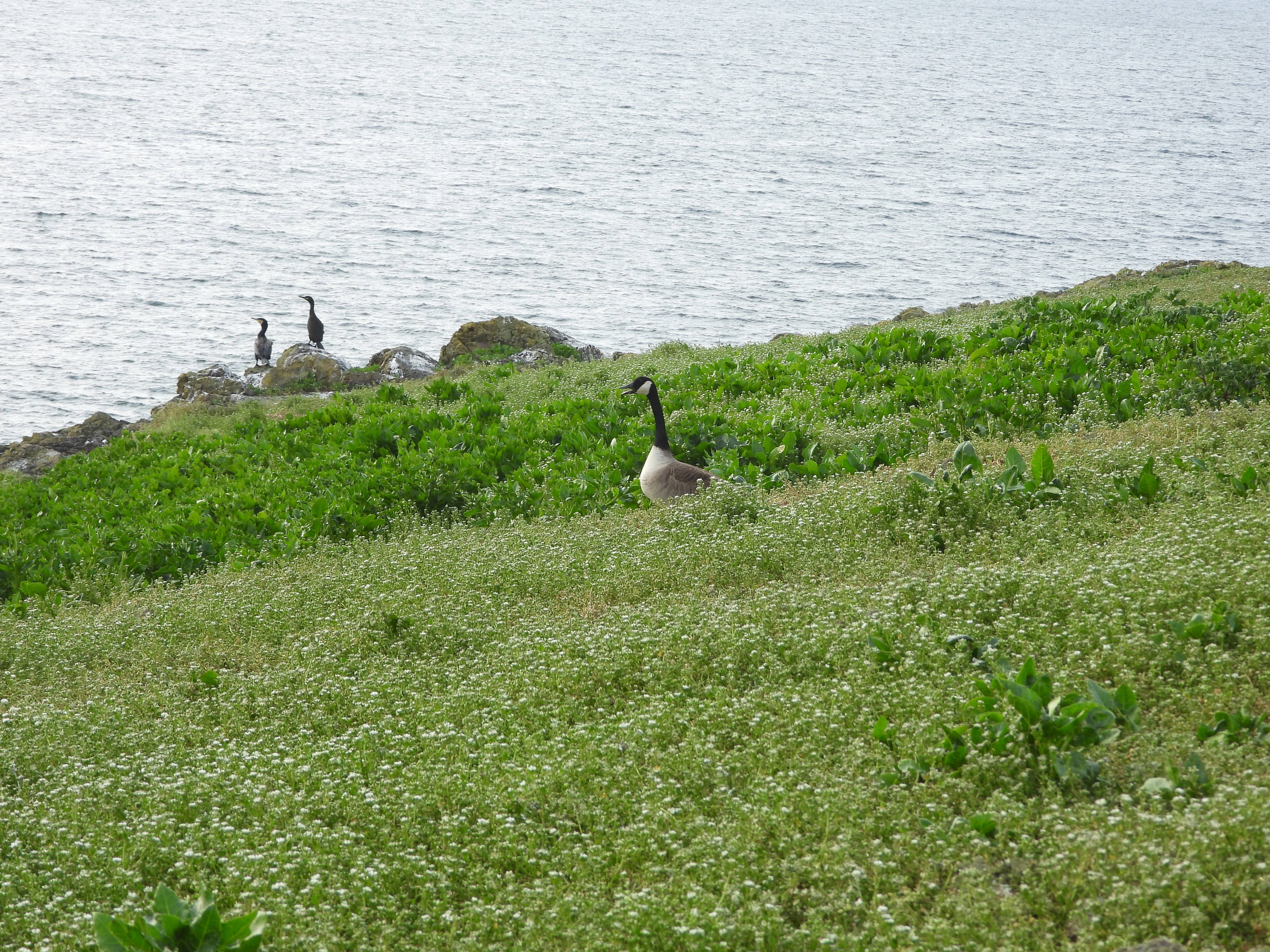
We took the opportunity of a fine evening to do a quick Great Black-backed Gull nest count on Mullion Island yesterday. Quite bizarrely, almost the first breeding bird we saw on landing was this Canada Goose, which actually had a nest with six eggs.


Nest with a view!

This is the first time we've even seen Canada Goose on the island, so quite a aurprise. At the other end of the island, we also found a second pair, but with an apparently failed nest with just one egg found near the empty nest.

As for the gulls, we covered most of the island, bar two areas close to nesting Shags, with a final count of 64 nests (178 eggs/chicks). Most were clutches of three eggs, some of which were just hatching, with just two small chicks seen.

Surprisingly we only saw one colour-ringed bird (L:DD2), which was a chick ringed on the island in 2018. Since then, it's been on its travels, seen on Ares beach in northern Spain in January, September and December 2020 and then at the nearby Playa de Santa Cruz in January 2021, so nice to see it back breeding.

Coincidentally, on a non-birding kayak earlier in the day (but always with camera at hand) we also recorded L:DD1 near Rosemullion Head, which is the first time it's been seen since being ringed on the island in 2018.


14 November 2021

Big gulls from points south

On the back of the Black-headed Gulls from earlier in the week (which all came from points east), this time it's Black-backed Gulls of interest (from points south). Of particular note today were two Great Black-backed Gulls sat close to each other on the island at Gothian Sands, Gwithian.

Yellow 2AA1 is a bird ringed as a chick on Herm, Channel Islands in 2013. It was first seen at Dawlish Warren in March 2014 before becoming a regular in Cornwall from January 2015.

Conversely, L:FZ3 is one of our own, ringed as a chick on Mullion Island earlier in 2021. So far it's the only of of this year's chicks to be seen abroad, seen on a beach in Guernesy on 18th September.

Incredibly though, it was back in Cornwall today, at Gothian Sands sat alongside 2AA1.

The other Black-back from the south was a Lesser seen on Hayle estuary. This is a Portuguese-ringed bird from a rehabilitation project run by RIAS.

13 July 2021

Busy seabird weekend

This long weekend has been a busy one, with various group members (and even a visitor from up-country) heading out to all parts of West Cornwall in search of (mostly) seabirds.

We started off with our annual gull-ringing trip over to Mullion Island, which was always going to be an unknown as we were too busy colour-ringing Cormorant chicks on our last visit to count the Great Black-backed Gull nests. We headed over in two kayaks and a dinghy, landing in a quiet cove and heading onto the top of the island. Working our way round we ringed just 10 chicks, but at least another 10 were too big to try to catch. Whilst there, we were also able to photgraph a couple of ringed adults, both of which had been ringed as chicks in 2016 but are now breeding on the island. Interestingly, one (L:CN5) had been ringed as a chick on Looe Island, but has been seen a few times around Lizard and Coverack since.


Next stop was a tour of Barn Owl sites around the Lizard, ringing chicks at 10 sites in total. Several of these later broods had just two chicks, in contrast to those earlier in the season that had three or even four chicks.

Back on the seabird theme, the next day found us Kittiwake ringing at Trewavas Head. Half of the team paddled round from Porthleven while the other half walked in with a ladder from Rinsey. We all reconvened at the cliffs to scramble down and kayak round to the main Kittiwake site. With very few birds successfully breeding, we only colour-ringed eight chicks, but at least this is better than the zero of the last two years. We also took the opportunity to read various colour rings at Trequean zawn and also managed to get photographs of two metal-ringed birds. One of these (ET44236) was ringed on the Isles of Scilly in 1999 and had been seen by us at the engine houses colony in 2018 as well, so is a healthy 22 years old now. The other rewmains a mystery at the moment, with the BTO team looking at the possible options for us of what might be a very old bird!


After an extra couple of owl boxes, we then headed down to Porthgwarra for dusk to set nets for Storm Petrels. This is often the busiest month for Stormies and true to form the first net round before midnight saw 45 birds in the nets, so it was a busy session for everyone. In total we ringed 95 birds, with recaptures of a French-ringed bird and others ringed on the Calf of Man (in August 2020), St David's, Pembrokeshire (in July 2020) and one of our own from Lizard (ringed in July 2020). Talking of Stormies, we also heard from the BTO that a bird we ringed at Lizard in August 2020 was recaught on Alderney, Channel Islands on 10th July.

So al in all a very productiove weekend of seabird ringing, contributing to our ongoing colour-ringing projects for some of these species.

26 June 2020

Mullion gull numbers

With the last of the (supposedly) calm seas for a while, we took the chance to get over to Mullion Island to ring any surviving Great Black-backed Gull chicks. At the start of the month we counted at least 59 nests with 146 eggs/chicks, but we know that survival is incredibly low to fledging, so we never know what to expect.

Worryingly the first chick we found on the island was tiny, perhaps only a week old and far too small to ring. With most chicks on Looe Island a good size now (we visited two days ago to ring them there) we wondered if Mullion birds were nesting far later and we'd struggle to find any chicks big enough to ring. The remainder of the island was a mixed bag though, with some nests still with eggs, one just in the process of hatching.


However, we did also find enough larger chicks to keep us occupied and in the end we colour-ringed 14 birds. This is still only 10% of the eggs/chicks we counted three weeks ago. but seems typical of recent years. We'll make a return trip in a couple of weeks time to see if the remaining chicks have survived, so the number may yet improve.


2013 2014 2015 2016 2017 2018 2019 2020
GBB Gull nests - 62 37 83 70 60 71 (59)
GBB Gull eggs/chicks 98 174 90 204 166 - 195 (146)
GBB Gull chicks ringed 4 17 12 13 5 3 16 14

For the first time we also saw not one but two of our own ringed birds on the island, of an age now where they're probably breeding. It was good to see the rings on these birds were still looking good, as in some cases they can wear quite rapidly, making them hard to read. See below examples from Looe Island (taken two days ago) of worn rings from 2010 and 2011.

LDA2 was ringed as a chick in 2015 and has been seen several times at Southerly Point, Lizard
and once at Coverack. It was last reported in November 2018.

With a remarkably similar history, LBH7 was ringed as a chick in 2014 and is also a frequent visitor to
Southerly Point, has also visited Coverack once and was last reported in September 2018.

Not all ring wear is even though, as the photos above and below are actually different sides of the same ring (L:AL8)


Strangely there were still also one or two Cormorant chicks in the nest which is very late, but most were long gone, leaving just their mallow-stick nests as evidence.


A sorry reminder of the times we're now living in

1 June 2020

2020 seabird update

It's been a while now since we've updated the blog, but to be honest lockdown has meant that we've not really been up to much anyway! We've been out reading gull rings locally and that's about it. But now lockdown has eased slightly we've been able to get out and start to look at Barn Owls and some of our seabirds. More on the owls later, but it was great to get out to Trewavas Head and Mullion Island recently and see how our birds are getting on.

A quick kayak out past Trewavas Head last week found very healthy numbers of Kittiwakes back on the ledges, including lots of 'new' birds at Trequean which has only recently been used. This new site appears to have been taken on by younger birds, with several birds we've ringed as chicks now sat on the ledges there. A quick paddle found 23 of our colour-ringed birds and four French birds which is a great start.

We then had our first trip over to Mullion Island today to check on the numbers of Great Black-backed Gulls nesting there. We weren't able to get over to ring any Cormorants this year due to lockdown, which was unfortunate as they were in a very accessible part of the island! But we were able to photograph and count nests earlier in the year and the count of at least 53 (and probably 57) is the highest we've seen in recent years.

Some of this year's fledged Cormorants enjoying the sun

Back to the gulls, there was one section of the island we couldn't cover due to nesting Shags and Cormorants, but we covered a majority of the island and counted 59 nests, mostly still with eggs. This is slightly down on previous years, as was the 146 eggs/chicks counted.

Great Black-backed Gull nest with a view


2013 2014 2015 2016 2017 2018 2019 2020
GBB Gull nests - 62 37 83 70 60 71 (59)
GBB Gull eggs/chicks 98 174 90 204 166 - 195 (146)
GBB Gull chicks ringed 4 17 12 13 5 3 16 ?
Cormorant nests 24 52 50 39 47 38 47 53-57
Cormorant chicks ringed 11 19 7 16 0 0 14 0

We'll be back over in a few weeks to see how those 146 have got on, so more on that later.

Newly-hatched Great Black-backed Gull chick


11 January 2020

French Shag on Looe Island

Recently we've been going back through some records and making sure that all of the French colour-ringed gulls seen on Looe Island (or more correctly St George's Island) over the years have been processed at the BTO end, thanks to the efforts of Claire the Warden's Assistant. There's been a Great Black-backed Gull colour-ringing project on the island since 2010 and Claire's efforts reading the colour rings are key to the success of the project. More details of the project can be found on the Cornwall Birds website.

But in amongst the gull records was a sighting of a colour-ringed Shag which is pretty unusual in the southwest. Claire photographed the bird by the jetty in December and it turns out it belonged to a French project, perhaps not surprising considering the closest UK projects are in west Wales and southern Ireland. K26 had been ringed as a chick in 2015 on Chausey, a small group of islands off the Normandy coast, geographically part of the Channel Islands group and managed as a bird reserve by the Groupe Ornithologique Normand.


It turns out that this is just the seventh record of a French-ringed Shag to be found in the UK. Of the previous six, three have been in Cornwall, sadly all young birds found dead in fishing nets (in 1982, 1984 and 1985). Of the other three, two were also in the southwest, found dead on the Isles of Scilly in 1981 and in Devon in 1989 (actually ringed 11 years earlier).


The only other record was also from the same French colour-ringing project, of a bird ringed as a chick in 2017 and seen later that year in Sheringham, Norfolk. The project on Chausey has ringed 1550 Shag chicks and remarkably these are the only two birds to have been seen in the UK, with the only other 'international' movements being two birds seen in The Netherlands. It's quite remarkable that these birds don't wander more widely, but know we all know what to look for we can hopefully find some more!

Thanks to Claire on Looe Island for sorting out all the records (and spending hours reading colour rings) and to Fabrice Gallien in France for the information on the birds and the project.

8 July 2019

Final Mullion totals

At the end of last week, a small team of four paddled over to Mullion Island for our last visit of the year, aiming to ring Great Black-backed Gull chicks. Productivity on the island is always poor so it's with trepidation that we land, not knowing how many chicks we'll find.


After a slow start, we finally started to find chicks, although most were single birds. But as we covered the top of the island we found groups of two and three chicks and we ended the evening ringing 16 birds, which is the second highest total since we started marking chicks in 2013.


2013 2014 2015 2016 2017 2018 2019
GBB Gull nests - 62 37 83 70 60 71
GBB Gull eggs/chicks 98 174 90 204 166 - 195
GBB Gull chicks ringed 4 17 12 13 5 3 16
Cormorant nests 24 52 50 39 47 38 47
Cormorant chicks ringed 11 19 7 16 0 0 14


 Having said that, finding just 18 chicks (16 ringed and two which were too big to approach safely) from 195 eggs/chicks earlier in the season is still pretty poor. We did also find four large dead chicks, but it wasn't clear how they'd died. It was also depressing to find a dead adult on top of the island with fishing line and presumably a hook in its throat, anothe victim of our polluted seas.


22 December 2018

Mullion gull's Spanish holiday

It was a bit of a surprise this week to receive an email asking for details of a sighting of one of our Mullion Island gulls from January 2018, as the finder had misplaced them. Lucky for us this was chased up as the bird had never actually been reported to us and is the first of our birds to be seen in Spain! So many thanks to Antonio Gutierrez for chasing this and to Juan Carlos Andrés for photographing the bird (below) in Ondarroa harbour on the north coast of Spain.


The ring code (L:BJ9) did sound familiar though and this bird had actually been photographed over the summer on a fishing boat in the Helford River back in Cornwall (below). What's interesting to see is just how worn this bird became over just five months.

Local fisherman Darren Thirlaway reports numerous
colour-ringed gulls from his boat on the Helford

This is only the fourth of our birds to be seen abroad: L:BF8 and L:BJ3 have both been seen at Lampaul, Ile de Ouessant, France and L:DC3 has been seen on Ile d'Yeu.

1 June 2017

Attacking the Mullion Mallow

With Mullion Island's Cormorants mostly all grown up, it was safe to head over to the island yesterday in two kayaks to do our first Great Black-backed Gull nest count of the year. A small team of four were able to cover most of the island, just missing out areas where the young Cormorants (and some Shags) were perched up on the cliff ledges.

Shag nests on the south side of the island
 

Whilst some birds were nesting on open ground, most were tucked deep in the Mallow that covers half of the island. This doesn't make nest counting very easy, hence needing a small team to be able to line-search through the vegetation, which is often over head height!


In total we located 70 nests, although we did miss some areas of the island. This compares reasonably well to the record count last year, but there were slightly fewer eggs/chicks than expected. Totals over the years for the island are shown below for info.


2013 2014 2015 2016 2017
GBB Gull nests
62 37 83 70
GBB Gull eggs/chicks 98 174 90 204 166
GBB Gull chicks ringed 4 17 12 13
Cormorant nests 24 52 50 39 47
Cormorant chicks ringed 11 19 7 16 0

Whilst on the island we were also hoping to ring some Shag chicks, but in the end only two right on top of the island were in a safe enough place to get to.

12 September 2016

A day of colour-ring reads

Since we've started colour-ringing Cormorants and Great Black-backed Gulls on Mullion Island we've also aimed to read rings on these birds locally and yesterday a few ardent colour-ring readers did a sweep of a few local sites.

Cormorant TBT (ringed on Mullion in April 2016) was at Drift Reservoir, whilst Hayle estuary only produced a single St Ives-ringed Herring Gull. Stithians Reservoir fared slightly better, with three of our Herring Gulls seen; one from St Ives and two from Falmouth, including W:001 which was one of the first birds ringed by the project.

W:001 as a chick on the roof of Falmouth Marine School in 2013
Elsewhere, one of our Herring Gulls was seen at Helston Loe Pool, but was flushed before the combination could be read - by the visiting Dalmatian Pelican!


Further along the coast, closer to Mullion Island, a walk along the cliffs at Halzephron (north of Gunwalloe) is sometimes productive, though another of our Cormorants sat offshore was too distant to confirm. We did manage to get close enough to a group of loafing Great Black-backs to find one colour-ringed bird, but it wasn't from Mullion Island.

Yellow 0JJ6 is a bird ringed as a chick off Herm in the Channel Islands in June 2010 and was seen around the islands until spring 2011. This isn't its first trip to Cornwall though, as it was seen on Hayle Estuary October 2011, with only two sightings since; back on Guernsey in September 2012 and then in France in May 2013. So where it's been for the last three years is unknown.

The small roost at Halzephron Cliffs, with Mullion Island in the background

4 July 2016

Full day of seabirds (and some cannibalism)

You know it's seabird time of year when you're heading out ringing for the day and your roof rack looks like this! Add to that a back seat full of paddles, buoyancy aids, drybag, VHF radio and an assortment of rings and colour rings and we were in for a long day...


First port of call was to take two boats over to Mullion Island to try to track down some of the 203 Great Black-backed Gull chicks/eggs we'd counted earlier in the year. Very few birds make it to a ringable size though, but with a record count this year hopes were high. The vegetation was, as ever, challenging and wading through the mallow and sea kale looking for chicks is a laborious job.


Even large chicks are remarkably good at hiding in low vegetation
True to form we found very few birds, which is always a bit depressing; a full sweep of the island found just 13 birds! These were all a good size to ring and colour ring, so it'll be interesting to see where these birds go wandering.

Some birds aren't quite so good at hide-and-seek though

Part of the reason so few birds survive to this stage was evident all around the island though, with at least 16 relatively freshly-dead chicks found. Some of these were pretty well-grown so it does look like predation (or more accurately cannibalism) remains a driver of the low productivity on the island. We're not sure how commonplace this is, but it doesn't seem to be the best strategy for a colonial-nesting bird!


Once we were back over from Mullion, we headed straight round to Praa Sands for the long paddle round to Trewavas Head to the second of our Kittiwake sites (only accessible by kayak). Unfortunately, the swell was way higher than forecast, so it wasn't safe to land and in any case the tide was really high which would have made accessing nest sites rather treacherous! This isn't the easiest of jobs at the best of times, as kayaking round the headlands with a double-ladder strapped to the side of your kayak is tiring to say the least. Makes landing interesting as well and I must admit we did get barrelled by a wave coming back in to Praa Sands.

Last job of the day (after an impromptu ringing group BBQ in the evening sun) was to make the most of a calm, new moon night to get nets up for Storm Petrels. The first net round before midnight produced over 25 birds so we knew we were in for a busy night, but sadly the Cornish mizzle came in at 1am and we had to beat a hasty retreat before the rocks got too slippy. But although we'd not made it to the busiest time of the night the total of 55 new birds was pretty good. It was a bit surprising to find these were all new birds, so we'll just have to go out again on Tuesday night and hope to recatch some ringed birds...