Showing posts with label mullion island. Show all posts

8 April 2024

Spanish Black-head and record Cormorant numbers

Mullion Island Cormorants are already well into their breeding season now, with some chicks almost ready to fledge. Our regular count from photos found a reciord 75 nests across the front of the island, beating the 73 nests in 2021 and 72 in 1999.

Annoyingly, photographs also showed an interloper in the colony. This white- (or blue-) ringed bird is likely to be from Wales or Ireland, but without being able to read the ring we'll never know. We're currently investigating the options for remote pan-tilt-zoom cameras, so watch this space.

The highlight from this weekend was a great sighting by Shaun Grose at Hayle. This Black-headed Gull (black ring N016) is actually the first Spanish-ringed bird to be seen in Cornwall, so quite special. In fact only 30 have ever been seen in the UK, so even at a national level this is notable.

It was ringed as an adult on the north coast of Spain in January 2022 and was regular there until 11th March 2022, then seen again in March 2023. It returned in January 2024 and was last seen there on 26th February, before being seen at Hayle. Presumably it's breeding somewhere in the UK, so one to look out for in future years.


24 May 2023

Strange goings on at Mullion Island

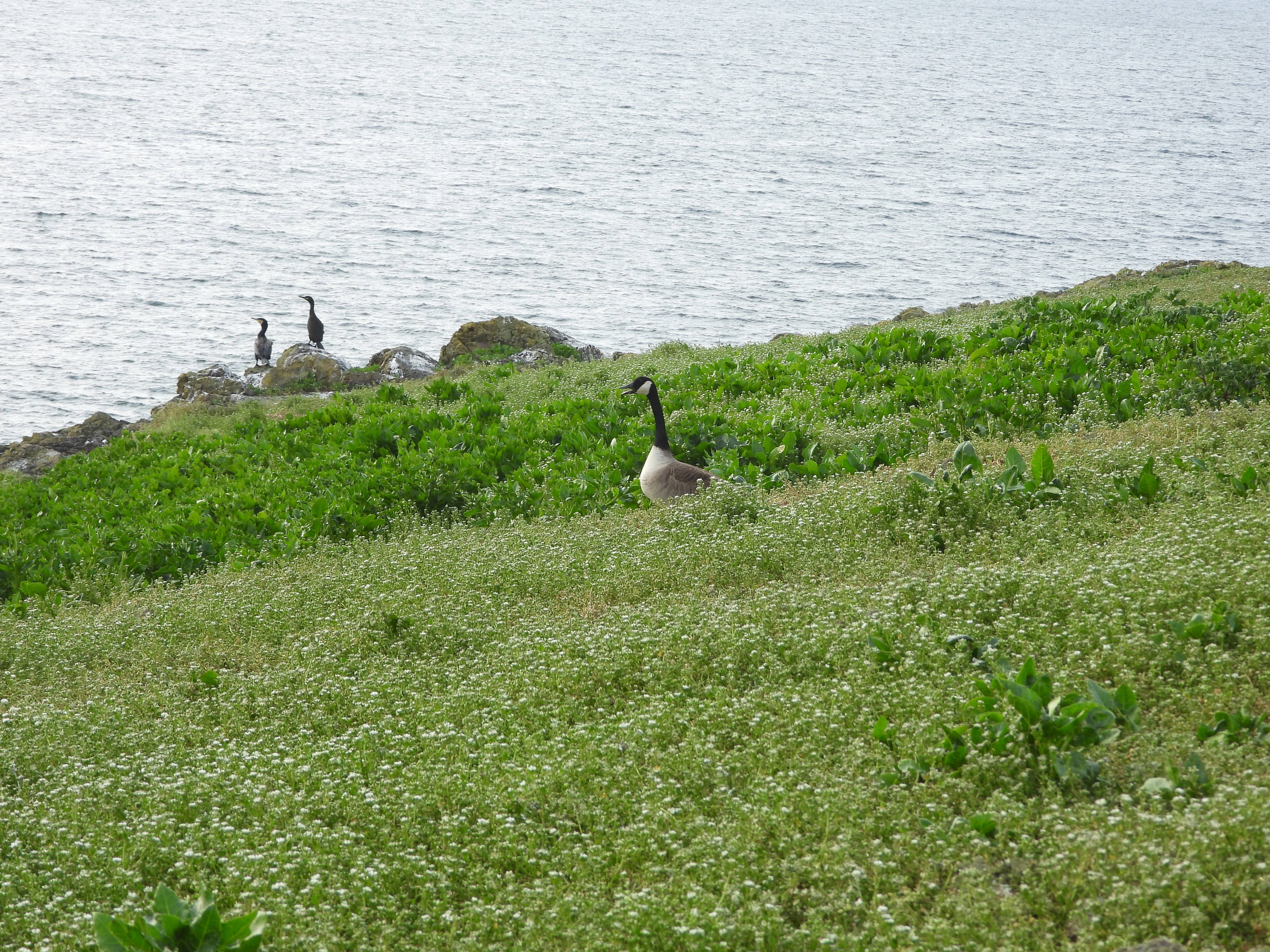
We took the opportunity of a fine evening to do a quick Great Black-backed Gull nest count on Mullion Island yesterday. Quite bizarrely, almost the first breeding bird we saw on landing was this Canada Goose, which actually had a nest with six eggs.


Nest with a view!

This is the first time we've even seen Canada Goose on the island, so quite a aurprise. At the other end of the island, we also found a second pair, but with an apparently failed nest with just one egg found near the empty nest.

As for the gulls, we covered most of the island, bar two areas close to nesting Shags, with a final count of 64 nests (178 eggs/chicks). Most were clutches of three eggs, some of which were just hatching, with just two small chicks seen.

Surprisingly we only saw one colour-ringed bird (L:DD2), which was a chick ringed on the island in 2018. Since then, it's been on its travels, seen on Ares beach in northern Spain in January, September and December 2020 and then at the nearby Playa de Santa Cruz in January 2021, so nice to see it back breeding.

Coincidentally, on a non-birding kayak earlier in the day (but always with camera at hand) we also recorded L:DD1 near Rosemullion Head, which is the first time it's been seen since being ringed on the island in 2018.


22 March 2022

So the breeding season starts

With the run of fine weather this week, it's the perfect chance to have a first look at some of our breeding seabirds. First stop yesterday was Mullion Island, where a few photographs from the cliffs revealed that the Cormorants were well into the breeding season, with some nests even having half-grown chicks exercising their wings. A scan of the photos revealed at least 69 nests, which is on a par with last year's record 73 nests.


We then sat on the cliffs overlooking Rinsey zawn and waited patiently for sitting Shags to shuffle and show us what they're up to. In total there were 11 occupied nests, but of these just one had laid, with three eggs present. This compares to well to previous years, with first eggs noted (from 2013-19) on 8th March, 22nd April, 13th March, 1st April, 22nd March, 9th April and 25th March.

13 July 2021

Busy seabird weekend

This long weekend has been a busy one, with various group members (and even a visitor from up-country) heading out to all parts of West Cornwall in search of (mostly) seabirds.

We started off with our annual gull-ringing trip over to Mullion Island, which was always going to be an unknown as we were too busy colour-ringing Cormorant chicks on our last visit to count the Great Black-backed Gull nests. We headed over in two kayaks and a dinghy, landing in a quiet cove and heading onto the top of the island. Working our way round we ringed just 10 chicks, but at least another 10 were too big to try to catch. Whilst there, we were also able to photgraph a couple of ringed adults, both of which had been ringed as chicks in 2016 but are now breeding on the island. Interestingly, one (L:CN5) had been ringed as a chick on Looe Island, but has been seen a few times around Lizard and Coverack since.


Next stop was a tour of Barn Owl sites around the Lizard, ringing chicks at 10 sites in total. Several of these later broods had just two chicks, in contrast to those earlier in the season that had three or even four chicks.

Back on the seabird theme, the next day found us Kittiwake ringing at Trewavas Head. Half of the team paddled round from Porthleven while the other half walked in with a ladder from Rinsey. We all reconvened at the cliffs to scramble down and kayak round to the main Kittiwake site. With very few birds successfully breeding, we only colour-ringed eight chicks, but at least this is better than the zero of the last two years. We also took the opportunity to read various colour rings at Trequean zawn and also managed to get photographs of two metal-ringed birds. One of these (ET44236) was ringed on the Isles of Scilly in 1999 and had been seen by us at the engine houses colony in 2018 as well, so is a healthy 22 years old now. The other rewmains a mystery at the moment, with the BTO team looking at the possible options for us of what might be a very old bird!


After an extra couple of owl boxes, we then headed down to Porthgwarra for dusk to set nets for Storm Petrels. This is often the busiest month for Stormies and true to form the first net round before midnight saw 45 birds in the nets, so it was a busy session for everyone. In total we ringed 95 birds, with recaptures of a French-ringed bird and others ringed on the Calf of Man (in August 2020), St David's, Pembrokeshire (in July 2020) and one of our own from Lizard (ringed in July 2020). Talking of Stormies, we also heard from the BTO that a bird we ringed at Lizard in August 2020 was recaught on Alderney, Channel Islands on 10th July.

So al in all a very productiove weekend of seabird ringing, contributing to our ongoing colour-ringing projects for some of these species.

3 May 2021

More Mullion Cormorants

We've never had the chance to make two Cormorat ringing trips over to Mullion Island, but the spacing of the colony this summer allowed us to get over safely again at the weekend. Thanks again to Lizard Adventure we took a few kayaks over and landed both side of the island so that we could corral the young birds in the Sea Mallow.

Some of the larger birds we let waddle off onto the top of the island so we could concentrate on the medium-sized chicks. With an efficient team, we were able to ring 25 chicks, 23 of which we also gave a coded orange ring which can be read at distance. We strictly limit our time on the island (to no more than an hour), so had to leave another dozen chicks unringed. But with a record number of nests this year (at least 73) this was always going to be a productive year. We sadly also didn't have time to count the Great Black-backed Gull nests on the island either, but with plenty of birds sat on eggs (and even a left-over Manx Shearwater meal) we hope they too will have a good year.


Across the two visits we colour-ringed 44 chicks this year which is by far the most we've ever ringed, so it'll be fascinating to see how these birds get on and where they end up. Thanks again to Lizard Adventure for the loan of their kayaks (and guide) and wehope to be working with them again soon when it's time to ring gull chicks.

8 April 2021

First Mullion Island trip of 2021

With the easing of restrictions coming at the perfect time, we took the chance of some flat clam seas this morning to make our first trip over to Mullion Island as part of our annual seabird monitoring. Earlier in the season we'd photographed the island from the clifftop and estimated 63 occupied nests, which is the most we've seen on the island since we started monitoring nests in 2013.

With enough big chicks to make a ringing trip worthwhile, with the help of Lizard Adventure we kayaked over and realised that we'd underestimated the number of nests, with the colony spreading deep into the Mallow, hence not visible from the mainland. We need to review the revised estimate, but at over 70 nests this is quite significant.

With three small ringing teams, we managed to ring 21 chicks, with 20 also large enough to take an orange colour ring to allow us to better track movements.


Many thanks to the ringing team and we were on and off the island in under 45 minutes, so minimising disturbance as much as possible. It'll be fascinating to see how this cohort of chicks fare and there may be more to ring yet as many nests still had unhatched eggs!

26 June 2020

Mullion gull numbers

With the last of the (supposedly) calm seas for a while, we took the chance to get over to Mullion Island to ring any surviving Great Black-backed Gull chicks. At the start of the month we counted at least 59 nests with 146 eggs/chicks, but we know that survival is incredibly low to fledging, so we never know what to expect.

Worryingly the first chick we found on the island was tiny, perhaps only a week old and far too small to ring. With most chicks on Looe Island a good size now (we visited two days ago to ring them there) we wondered if Mullion birds were nesting far later and we'd struggle to find any chicks big enough to ring. The remainder of the island was a mixed bag though, with some nests still with eggs, one just in the process of hatching.


However, we did also find enough larger chicks to keep us occupied and in the end we colour-ringed 14 birds. This is still only 10% of the eggs/chicks we counted three weeks ago. but seems typical of recent years. We'll make a return trip in a couple of weeks time to see if the remaining chicks have survived, so the number may yet improve.


2013 2014 2015 2016 2017 2018 2019 2020
GBB Gull nests - 62 37 83 70 60 71 (59)
GBB Gull eggs/chicks 98 174 90 204 166 - 195 (146)
GBB Gull chicks ringed 4 17 12 13 5 3 16 14

For the first time we also saw not one but two of our own ringed birds on the island, of an age now where they're probably breeding. It was good to see the rings on these birds were still looking good, as in some cases they can wear quite rapidly, making them hard to read. See below examples from Looe Island (taken two days ago) of worn rings from 2010 and 2011.

LDA2 was ringed as a chick in 2015 and has been seen several times at Southerly Point, Lizard
and once at Coverack. It was last reported in November 2018.

With a remarkably similar history, LBH7 was ringed as a chick in 2014 and is also a frequent visitor to
Southerly Point, has also visited Coverack once and was last reported in September 2018.

Not all ring wear is even though, as the photos above and below are actually different sides of the same ring (L:AL8)


Strangely there were still also one or two Cormorant chicks in the nest which is very late, but most were long gone, leaving just their mallow-stick nests as evidence.


A sorry reminder of the times we're now living in

1 June 2020

2020 seabird update

It's been a while now since we've updated the blog, but to be honest lockdown has meant that we've not really been up to much anyway! We've been out reading gull rings locally and that's about it. But now lockdown has eased slightly we've been able to get out and start to look at Barn Owls and some of our seabirds. More on the owls later, but it was great to get out to Trewavas Head and Mullion Island recently and see how our birds are getting on.

A quick kayak out past Trewavas Head last week found very healthy numbers of Kittiwakes back on the ledges, including lots of 'new' birds at Trequean which has only recently been used. This new site appears to have been taken on by younger birds, with several birds we've ringed as chicks now sat on the ledges there. A quick paddle found 23 of our colour-ringed birds and four French birds which is a great start.

We then had our first trip over to Mullion Island today to check on the numbers of Great Black-backed Gulls nesting there. We weren't able to get over to ring any Cormorants this year due to lockdown, which was unfortunate as they were in a very accessible part of the island! But we were able to photograph and count nests earlier in the year and the count of at least 53 (and probably 57) is the highest we've seen in recent years.

Some of this year's fledged Cormorants enjoying the sun

Back to the gulls, there was one section of the island we couldn't cover due to nesting Shags and Cormorants, but we covered a majority of the island and counted 59 nests, mostly still with eggs. This is slightly down on previous years, as was the 146 eggs/chicks counted.

Great Black-backed Gull nest with a view


2013 2014 2015 2016 2017 2018 2019 2020
GBB Gull nests - 62 37 83 70 60 71 (59)
GBB Gull eggs/chicks 98 174 90 204 166 - 195 (146)
GBB Gull chicks ringed 4 17 12 13 5 3 16 ?
Cormorant nests 24 52 50 39 47 38 47 53-57
Cormorant chicks ringed 11 19 7 16 0 0 14 0

We'll be back over in a few weeks to see how those 146 have got on, so more on that later.

Newly-hatched Great Black-backed Gull chick


8 July 2019

Final Mullion totals

At the end of last week, a small team of four paddled over to Mullion Island for our last visit of the year, aiming to ring Great Black-backed Gull chicks. Productivity on the island is always poor so it's with trepidation that we land, not knowing how many chicks we'll find.


After a slow start, we finally started to find chicks, although most were single birds. But as we covered the top of the island we found groups of two and three chicks and we ended the evening ringing 16 birds, which is the second highest total since we started marking chicks in 2013.


2013 2014 2015 2016 2017 2018 2019
GBB Gull nests - 62 37 83 70 60 71
GBB Gull eggs/chicks 98 174 90 204 166 - 195
GBB Gull chicks ringed 4 17 12 13 5 3 16
Cormorant nests 24 52 50 39 47 38 47
Cormorant chicks ringed 11 19 7 16 0 0 14


 Having said that, finding just 18 chicks (16 ringed and two which were too big to approach safely) from 195 eggs/chicks earlier in the season is still pretty poor. We did also find four large dead chicks, but it wasn't clear how they'd died. It was also depressing to find a dead adult on top of the island with fishing line and presumably a hook in its throat, anothe victim of our polluted seas.


8 June 2019

Breeding season hotting up!

It's been a while since we updated on the start of the breeding season, so this is a quick tour of some of what we've been up to recently. Most recently we've had our first session out ringing Storm Petrels and managed to get teams out to Lizard and Porthgwarra on the same night. PG won out, catching 52 birds, including birds originally ringed in France and on Skokholm Island, Wales (as an adult in 2016). The Lizard team caught 22 birds, but also two birds from elsewhere: birds ringed in 2018 at Portland, Dorset and on Bardsey Island in North Wales.

Aside from that, we've mostly been counting and ringing chicks recently, including Chough, Dipper, Cormorant, gulls and Kittiwakes. It's been fun as well monitoring successive Robin nesting attempts at Penventon Garden Centre, nesting in amongst some of the plant displays! The first fledged two chicks, with two dying in the nest (lack of food due to the baked-hard ground perhaps?), and the second attempt (photographed below) currently has five chicks.


We're also well into the first checks of the Barn Owl season and whilst some pairs are only just hatching chicks now, others already have chicks that are 5-6 weeks old!

One of a brood of five chicks ringed last week on the Lizard

A rather unusual barrel nestbox we found removed from an old site near Marazion.
There must be some pirate heritage in birds that nest is such an impressive barrel.
Whilst most of the owls we've been ringing have been in boxes, it's also been busy in the owl hospital at the Screech Owl Sanctuary. We've already made several visits this year to ring birds before release and our last visit saw us ringing three small chicks (including the very rusty bird below), an older chick and an adult.


Away from ringing, we've now managed to count the gull nests on Mullion and the total of 71 is on par with previous years, though the number of eggs and chicks is second highest we've seen.


2013 2014 2015 2016 2017 2018 2019
GBB Gull nests - 62 37 83 70 60 71
GBB Gull eggs/chicks 98 174 90 204 166 - 195
GBB Gull chicks ringed 4 17 12 13 5 3 -
Cormorant nests 24 52 50 39 47 38 47
Cormorant chicks ringed 11 19 7 16 0 0 14

We've also seen the first Kittiwake eggs of the year, at Rinsey. At the same time some of the Shag chicks are already close to fledging!

The main zawn at Rinsey, sadly now pretty much devoid of Kittiwakes
and with drastically-reduced Shag numbers


Next on the agenda is trying to up our numbers if colour-ringed adult Kittiwakes and then we'll be thinking about gulls and more owls! It never ends...