Showing posts with label herring gull. Show all posts

18 May 2023

Herring Gull and Kittiwake wanderings

We've not blogged anything for a while, but with a quiet winter devoid of Siberian Chiffchaffs there's not much to report! But this week we've had a couple of exciting colour ring sightings, so thought we'd share.

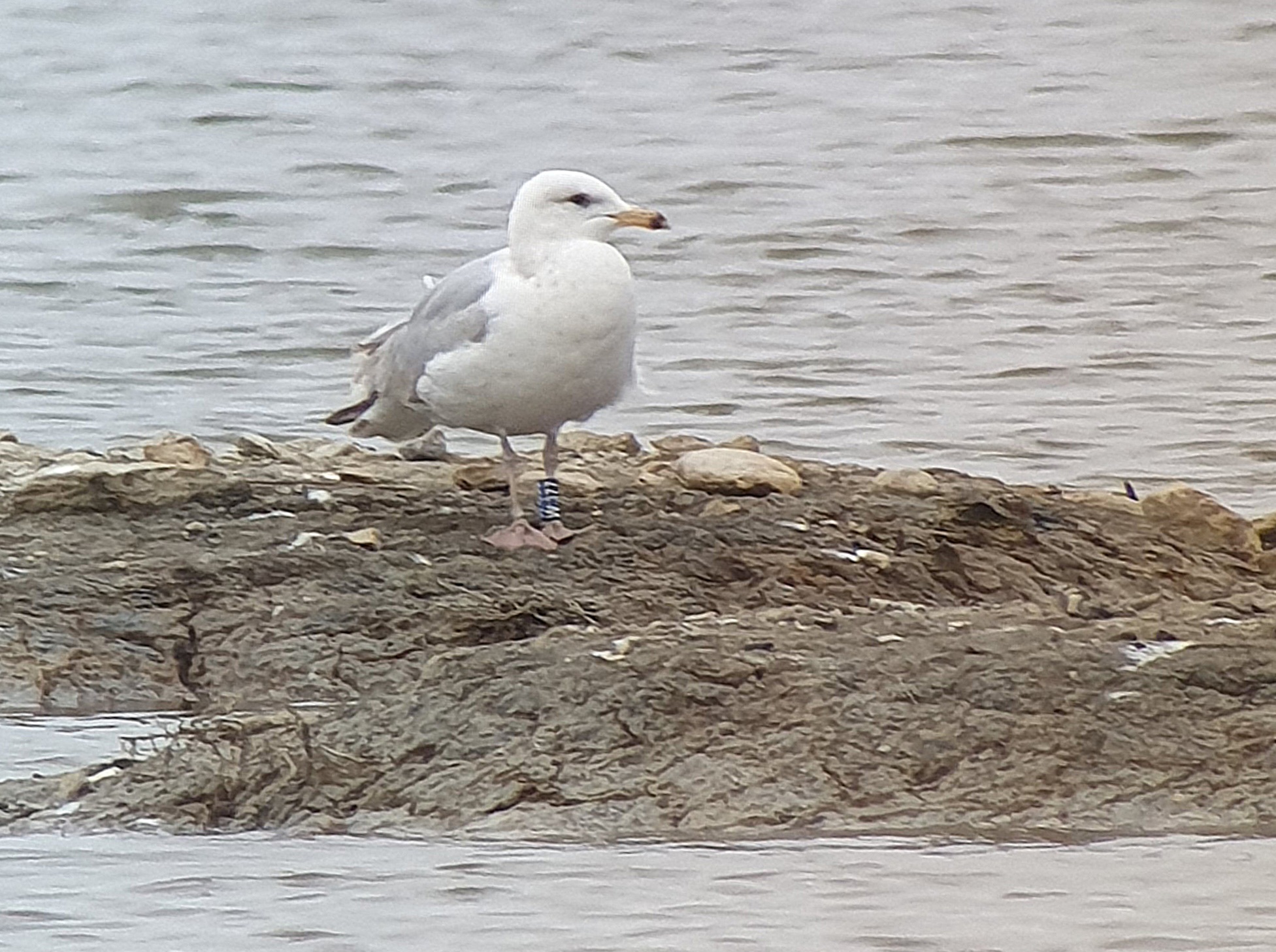
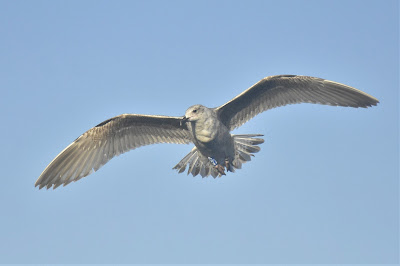
On 4th May we heard from the assistant warden at the newly-accredited Lundy Bird Observatory, with news of one of our blue-ringed Herring Gulls; W:377, which was ringed as a chick on a roof at Tregoniggie Industrial Estate, Falmouth in June 2020. It is a bit of an explorer though, having been seen locally until August 2021, before being report on the French coast in February 2022. The next winter (January 2023), it was reported from a French landfill site, before returning to the coast in March. It was last reported there on 6th April before swapping France for Lundy.

W377 at Stithians in August 2021
W377 at Marais de Suscinio in February 2022 (Catherine and Michel Marcaul)

Newly-moulted W377 back at Marais de Suscinio in March 2023 (Anne-Sophie Hochet)
W377 on Lundy in May 2023 (Luke Marriner)

Then on 15th May, we had a report of one of our Trewavas Head Kittiwakes, seen pair bonding and attending the beginnings of a nest maintenance on Skellig Michael, Co. Kerry, Ireland. KJ was ringed as an adult at Trewavas Head in 2017 and bred there (when the site was doing well) until 2020. As the main site started to fail, it then moved a short distance along the coast to Trequean Zawn in 2021, but then wasn't seen in 2022.

KJ on its travels (Brian Power)

We rarely see movements between our sites and Wales/Ireland as it's far more likely for us to share birds with the French colonies. In fact, this is our first Kittiwake to be found in Ireland and only the second Cornish-ringed bird to make the trip.

31 December 2021

Our first Herring Gull to Spain

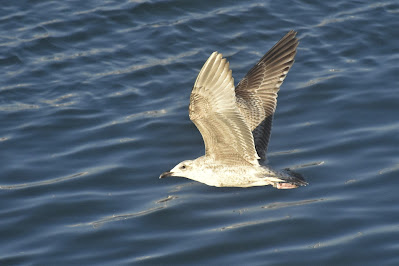
As 2021 draws to a close, we had an exciting late Christmas present in the form of our first ever Herring Gull sighting from Spain. As we seem to have found, it's our rehabilitated chicks that tend to wander the most and this was no exception, as W:573 was an orphaned chick released at Stithians Reservoir in August 2021 and photographed in NW Spain yesterday.


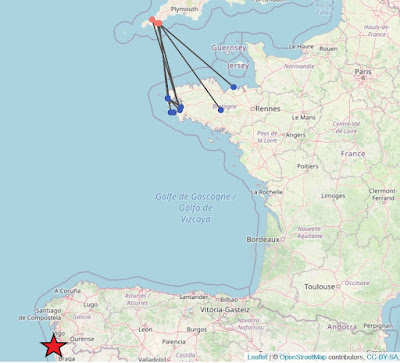
This is in fact the first Cornish-ringed Herring Gull ever to be found in Spain, with the only other foreign movements reported being to France. The map below shows all of our own foreign movements to date from our colour-ringing, with the location of W:573 marked by the red star, so you can see just how unusual the sighting is!

To put this into some context, the BTO's Online Ringing Report shows only 31 previous records of BTO-ringed Herring Gulls found in Spain, so W:573 really is a special. It'll be interesting to see how long it stays so far south (at the far southern edge of the wintering range for the species) and whether or not it eventually returns to Cornwall.

Many thanks to Nicolás Magdalena García for reporting this bird and allowing us to use his great photos.

3 October 2020

Ageing gulls

I don't mean ageing as in the dark art of knowing if that dappled Herring Gull is a third or fourth calendar year bird, but more some of the interesting changes in plumage and bare parts we see as our colour-ringed Herring Gulls grow up.

W:245 was ringed as a chick on the University of Exeter campus in July 2018 and has been seen just seven times at various sites local to Falmouth since. It's interesting to look at how its bill colour has changed this year though, seen in the montage below.

It's also interesting to see how moult progresses through the year as birds rapidly change appearance. W:178 was also a chick ringed in 2018, this time in the middle of Falmouth town, and has been seen eight times since. Both photos below show W:178 at Stithians Lake, in June and September, but note how quickly it has grown through new flight feathers (with 'mirrors' on the tips) and also adult-type wing coverts.

W:178 on 29th June

W:178 on 25th September

Some birds really do change appearance in a matter of months as well. W:249 was also a 2018 campus chick and has been seen eight times in the local area. Below are a few photos of W:249 just from this year and the change is striking, although photos can be deceiving as the bird looks to have taken a step backwards in its moult in September!

January

August

September

3 July 2019

23-hour ringing day!

You know it's summer when you're up before 5am to be out ringing gull chicks and then back home at 4am having been ringing Storm Petrels all night!

This last week has seen various small teams out on rooftops around Falmouth ringing gull chicks, all part of the ever-growing project looking at the behaviour and movements of urban Herring Gulls. So far we've ringed 25 birds on St Mary's School, 20 on Tregnoniggie Industrial Estate, 65 on the university campus roofs in Penryn and various other smaller groups.

Ringing chicks on the roof of Wilko in Falmouth

It's was also full moon last night and perfect weather for some Storm Petrel ringing, so a small team headed down to Gwennap Head, Porthgwarra. As the wind dropped the birds started arriving at the nets and we were set for a busy night!


The final tally was 114 new birds ringed and six birds retrapped that weer already ringed. Three of these were birds we'd ringed previously, one just a month ago at Lizard. Another was a bird we ringed at Porthgwarra in July 2018 that was recaught in North Wales just a week later. Another has a slightly more interesting history. It was ringed at Porthgwarra in June 2015, then recaught on Skokholm Island in July 2015 and in Ceredigion 10 days later. In an almost identical occurence it was recaught again on Skokholm Island in August 2018 and in North Wales nine days later!

Other ringed birds came from Co Mayo (ringed in 2008, so a good age), Skokholm Island in 2018 and also a Spanish-ringed bird. This is only the seventh Spanish-ringed Storm Petrel to be found in the UK, but the fourth at Gwennap Head (after birds in 2008, 2009 and 2017)! Others have been caught at Pendeen (in 2005), Tyne & Wear (in 1992) and two in Scotland.

15 November 2018

Welsh Stormies and Falmouth gulls

It's been a while since I've got round to blogging, but then it seems of late we've just been looking at colour-ringed gulls and not much else! But we did receive some interesting reports from BTO recently, involving Storm Petrels recaught at Skokholm Island in south Wales earlier in the year.

The Bird Observatory recaught no fewer than 11 birds ringed by us, including four on just one night (22nd July, when 142 were caught on the island). Of these 11, six had been ringed in 2015 and 2017 at Hot Point, Lizard, with the other six all ringed on 15th July at Gwennap Head, Porthgwarra. This further highlights the link between sites in the English Channel and Irish Sea.

As part of a PhD application for one group member we've also been looking at some of our gull data from Falmouth, so thought we'd share. So across all of our gull sites we've colour-ringed 276 birds, including 199 chicks. Just in Falmouth the figure is 140 birds colour-ringed, of which 85 were chicks. These Falmouth birds have then generated 509 sightings, with 63 of the 140 being seen at least once after ringing. Some of these have only been seen once, but our most reported bird has been seen 60 times now.

Number of resightings of individual birds colour-ringed in Falmouth

Obviously the more sightings we receive the better we understand their behaviours and movements, so if you are a local birder then please keep an eye out for our blue-ringed birds.

25 August 2015

St Ives Herring Gulls back on the TV

For anyone that missed the original airing of the programme, some of our gull-tracking work that featured on the BBC is available again on iPlayer for the next couple of weeks. The programme 'Nature's Boldest Thieves' looked at the food-snatching behaviour of birds in St Ives and included some work on birds that we colour-ringed and also tracked using GPS data-loggers.

The programme can be viewed on iPlayer here, or just click on the image below.

http://bbc.in/1BaShOV


The bits to look out for on our work are at 14:30, 32:15 and 41:50. The work is still ongoing, so if anyone comes across any of our blue-ringed gulls then do let us know (details on the contacts page).

18 July 2015

Foreign gulls and legless gulls

The blog has been a bit quiet recently, but that's mainly due to a long overdue holiday in Turkey! But I came back to a bit of a flurry of gull reports, all of which were quite interesting...

The first two were a bit sad, as Herring Gull W:062 appears to have lost a leg! It was seen with both legs intact in amongst the thousand other gulls in Cadgwith Bay in January, so has obviously suffered a mishap since then. It was reported from Swanpool, having been ringed locally in Falmouth in 2014.


We also heard that W:197 from St Ives had been found with a broken wing and broken leg in St Ives, so had to be euthanased by a local vet. Better news came in the form of W:060, originally ringed on Falmouth High Street, which is now also on it's holidays, being seen in France. This is the first foreign sighting of one of our Herring Gulls, so was great news!

We've also only ever had one previous foreign sighting of one of our Great Black-backed Gulls, so receiving two in a week was a surprise. Our only other foreign sighting was L:BF8, ringed in Falmouth and seen in France in October 2014, and it apparently liked France as it was reported from a different site again at the start of May (delayed as reported by letter). Also heading south was L:BJ3, ringed on Mullion Island in 2014 and seen at Lizard Point twice in August 2014. It was seen on Chouet Landfill, Guernsey on 13th July and it's about time one of our birds made it to the Channel Islands.

Apart from this, since the last blog update we've been doing some ringing, so below are a few highlights in the form of pretty pics!

It was another year of low productivity for our Great Black-backed Gulls on Mullion Island, with just nine chicks making it to an old enough age to colour-ringed
Our Kittiwakes have been doing slightly better, with 25 chicks and 15 adults now ringed at Trewavas Head
It's not been such a good year for resightings of French-ringed birds though, with just five birds seen. This bird was ringed at Ponte du Raz, France in 2002 and has been seen at Trewavas Head in 2012 and 2015.
This is also a French bird, ringed as a chick in 2007 and seen for the first time at Trewavas Head this year. Caught inadvertently, we noticed that the colour rings (in particular yellow) were starting to fade so we replaced them with one of our numbered rings.
Away from seabirds, we are also continuing to ring rehabilitated owls at the Screech Owl Sanctuary, these being some of the eight young Tawny Owls ringed recently.

26 June 2015

Tit-tastic

Hopefully this won't be blocked by too many browsers, but our latest CES visit at Gunwalloe was a bit of a Blue Tit festival, with several broods apparently converging on the reedbed for the morning!

The total for the day of 87 birds (24 from an extra non-CES 30' net) was dominated by Blue Tits, with 32 caught, including several adults. But most were noisy, newly-fledged juveniles testing out their biting skills for the first time!

If ever there was an individual that demonstrated why birds
need an annual feather moult, this was it!
The rest of the catch included 13 newly-fledged Reed Warblers (and 7 adults), 10 Sedge Warblers and a scattering of Bkackcap, Bullfinch, Reed Bunting etc... We were also reunited with Y101092, a female Cetti's Warbler ringed in June 2011 and only recaught twice since (in July 2011 and June 2014).

In other news, we also recently had a kayak expedition out to Trewavas Head and Rinsey to ring a few more adult Kittiwakes. In an eventful day, including losing a kayak and capsizing a kayak, we colour-ringed a further 15 adult birds as part of our RAS study. We were also able to resight a few birds from previous year, including a single French-ringed bird.


It's rare to see a first-summer Kittiwakes back at a colony,
so this bird at Trewavas Head was a surprise
On the way back we stopped off to ring a few Herring Gull chicks at Rinsey: our natural 'control' site for the Falmouth urban gull work. We rounded up nine birds, so it was depressing to see broods of three later in the week with just two ringed!


25 January 2015

St Ives gulls on the BBC

We've blogged a bit about some of the gull work we've been involved with in St Ives (here, here and here), but the BBC show that funded this was eventually broadcast earlier this evening on BBC1. If you're quick you can catch it on iPlayer for the next few days (available here).

http://www.bbc.co.uk/iplayer/episode/b0513l8q/natures-boldest-thieves

The programme is worth a watch, but for those pressed for time, the amusing bits to look out for are us catching a few birds from 14:40 and a hint at some of the GPS logger results from 32:20, although they gloss over the fact that since the summer we've accumulated over 35 million data points from these birds!

7 January 2015

Winter wanderings of a St Ives gull

We've recently been able to look at some of the data from the GPS data-loggers on the three gulls in St Ives and one of these in particular is quite interesting. Logger 4036 (colour ring Blue W:181) was a breeding male originally ringed on the roof of the Co-op in St Ives. Over November-December 2014 it took a couple of trips out to the north, visiting Lundy Island for an overnight stop on one date. A second trip then took it out to both Great and Little Saltee Islands, a brief visit to some fields near Duncormick (as far as 240km from St Ives) and then a visit to Hook Head.


What is also interesting is the time it spent at sea on its return, with a cluster of points in the Celtic Sea. It is possible that it was either following fishing boats feeding or a resting bird 'riding the tide'.

W:181 has always been a very pelagic bird, and the track below (in yellow) shows some of its movements during the breeding season, again wandering out into the Celtic Sea.


Many thanks to Peter Rock for getting to grips with the data and producing the maps here.

26 November 2014

Helston gulls and our first Skylarks

After putting up a new Barn Owl box with the National Trust yesterday, I couldn't resist stopping off with a loaf of bread at Helston Boating Lake to see what gulls were around. I soon had a good gathering of Black-headed Gulls, along with a few other scroungers. The few birds there included the regular White 23D8 from Berkshire, but also a young Herring Gull with a nice blue ring!


W:047 was ringed on an industrial estate roof in Falmouth in June. This is only 15km from Falmouth, but still interesting to see it leaving the town rather than hovering round eating chips.

White 23D8 and Blue W:047 hanging out together
Later in the afternoon we then set nets out at Predannack in the hope of catching some of the 100+ Skylark using the set-aside fields there. Setting up seven nets in an 'H' pattern, we put a 'tape' on pre-dawn and at first light walked the adjacent field, moving over 30 birds towards the nets. But with a little too much dawn light, we only managed to catch eight birds, but now know better for next time (tomorrow). These are the first Skylark ringed by the group and weighing in at almost 40g some were quite impressive!


Swithching the 'tape' (actually an MP3 player) to Meadow Pipit, which seem to be less wary of nets in daylight, we topped up the day's catch with 16 Meadow Pipits.

Bit hard to see, but the 'H' of nets now furled for tomorrow morning

16 September 2014

Another gull coincidence

Following the bizarre gull coincidence we blogged about before (here), they just keep coming! On the weekend I needed to go out to St Ives to replace a battery on one of the relay stations (that bounce the downloaded logger data to our base station) and also to retrieve one of the loggers from the Co-op roof that had either fallen off or been removed by one of the gulls... We knew the bird was alive and well as it had been seen on Hayle estuary by ring-reader extraordinaire Steve Lister (holidaying Leicestershire county recorder), but the tag was still just transmitting from the rooftop!

One of the two relay stations in St Ives
The retrieved logger, unfortunately now minus aerial
Whilst I was there it would be rude to not have a look on the beach for some of our birds... As ever, W:186 was still mugging children on the beach by Rod's Deckchairs (now accompanied by two begging juveniles) and on the beach by the ice cream parlour was W:194.

W:194 on the beach at St Ives, 20m from where it was ringed!
Once these jobs were done I decided to drop in to Hayle estuary to have a quick look through the gulls there. Not only did I bump into Steve Lister (and show him the logger dropped by the bird he'd seen earlier in the week), but also spotted a couple of our St Ives birds. Nothing really special there, until I realised that one of them was W:194 which must have followed me down from St Ives! I worked out I'd been watching it on the beach in St Ives just after 3pm and then watching it on the estuary at Hayle at 3:50pm. OK, so it's only a matter 4km from St Ives to Hayle as the gull flies, but I was impressed by the coincidence!

W:194 45 at Hayle, less than an hour after I'd been watching it in St Ives

18 June 2014

A day of gull coincidences

Yesterday two of us had a nice day out at the seaside, eating ice creams in St Ives. Well when I say eating ice creams I mean tempting in a few food-snatching gulls to drop a hand net over. Three ice creams and a bit of sandwich later and we'd ringed and, more importantly, colour-ringed 10 Herring Gulls. It proved to be quite a spectacle on the packed prom and beach of St Ives, with small crowds of tourists and locals gathering every time we struck - good PR but a bit nerve-wracking!

Some birds didn't seem overly worried by the whole affair, with the first bird we ringed back in the same spot 30 minutes later chasing other gulls off his patch. But after an afternoon along the same strip of prom it did become strangely gull-free, so obviously word had spread of what we were up to.

Blue W186 back on territory by Rod's Deckchairs on the prom

Leaving St Ives, we headed south towards Nanceldra where we knew that some of our GPS data-logger gulls hang out. One favourite spot is the largest dairy farm in the area, with roofs full of gulls and crows. As we passed another favourite field we noticed a bird with unusually rather fat legs sat on a telegraph pole. A rapid stop in the middle of the road later and we could confirm this was W:182, a nesting female ringed by us in May.

Spot the fat-legged gull
A slightly better digi-scoped view of W:182,
though you can't quite see the backpack-mounted data-logger
We then continued on to another area where birds have recently been seen, and speaking to the owners they confirmed that there had been lots of mowing recently which is what the birds have been homing in on - mowed rodents! Bizarrely they even knew of the tagging project through friends who own the B&B we stayed in back in May in St Ives!


But an even more bizarre coincidence was that this same couple had found one of our Barn Owls dead last year and promptly popped into the house and presented us with the ring back! They also knew the owner of the farm where we ringed the bird two years ago and while we were there it seemed rude to not check their three owl boxes, but sadly no birds.

So a very crazy afternoon of coincidence and certainly worth the minor injuries sustained diving after gulls on the prom...


Knuckles are over-rated anyway

12 May 2014

Rooftop gulls and garden demos

We've had a pretty busy week, so are a bit behind on the blog, so only a quick update here...

At the end of last week we were out filming with Finestripe productions, who are working on a BBC1 programme (Britain's Boldest, out in the autumn) looking at our interactions with wildlife, including pasty-snatching urban gulls. So we were out for the day in St Ives fitting four breeding Herring Gulls with GPS loggers, which then transmit via relay stations to a base station positioned for the summer in a local B&B. At the moment the loggers are just recording a position every 10 minutes, but at the height of pasty-snatching behaviour they'll record a position several times a minute, allowing us to follow these birds around the town.

One of our Herring Gulls with its solar-powered GPS logger
The loggers also have an inbuilt accelerometer, so we'll hopefully be able to see the exact behaviours of these birds as well. Exciting times!

Not a bad place to live...
Birds were caught with a modified pet run, now a cage trap!
Rooftop filming with urban gull guru Peter Rock
We then changed location at the weekend, setting up at Trebah Gardens for a weekend Wildlife Celebration with Cornwall Wildlife Trust. We've run a ringing demo at this annual event for a few years now, but this is the first time at this new location (it used to be at the Lost Gardens of Heligan). Things didn't look good, as all of our nestboxes (admittedly only put up in February) were empty and the peanut feeders had been helpfully emptied by local squirrels, but we persisted anyway...

In the end, we caught just about enough birds to keep the crowds happy, including plenty of Robins (always a hit), Nuthatch, Great Spotted Woodpecker, Chiffchaff, Blackcap and a couple each of Blue, Great and Coal Tit.

Robins are always popular with the kids
These demos are a great way to get kids hands on and enthused about wildlife and we were pretty busy on both days. We also managed to recruit a couple more potential trainees, at least one new Barn Owl site and another good gull contact, so good for us too!


Big thanks to Emma for helping out over the weekend and also for taking some pics.